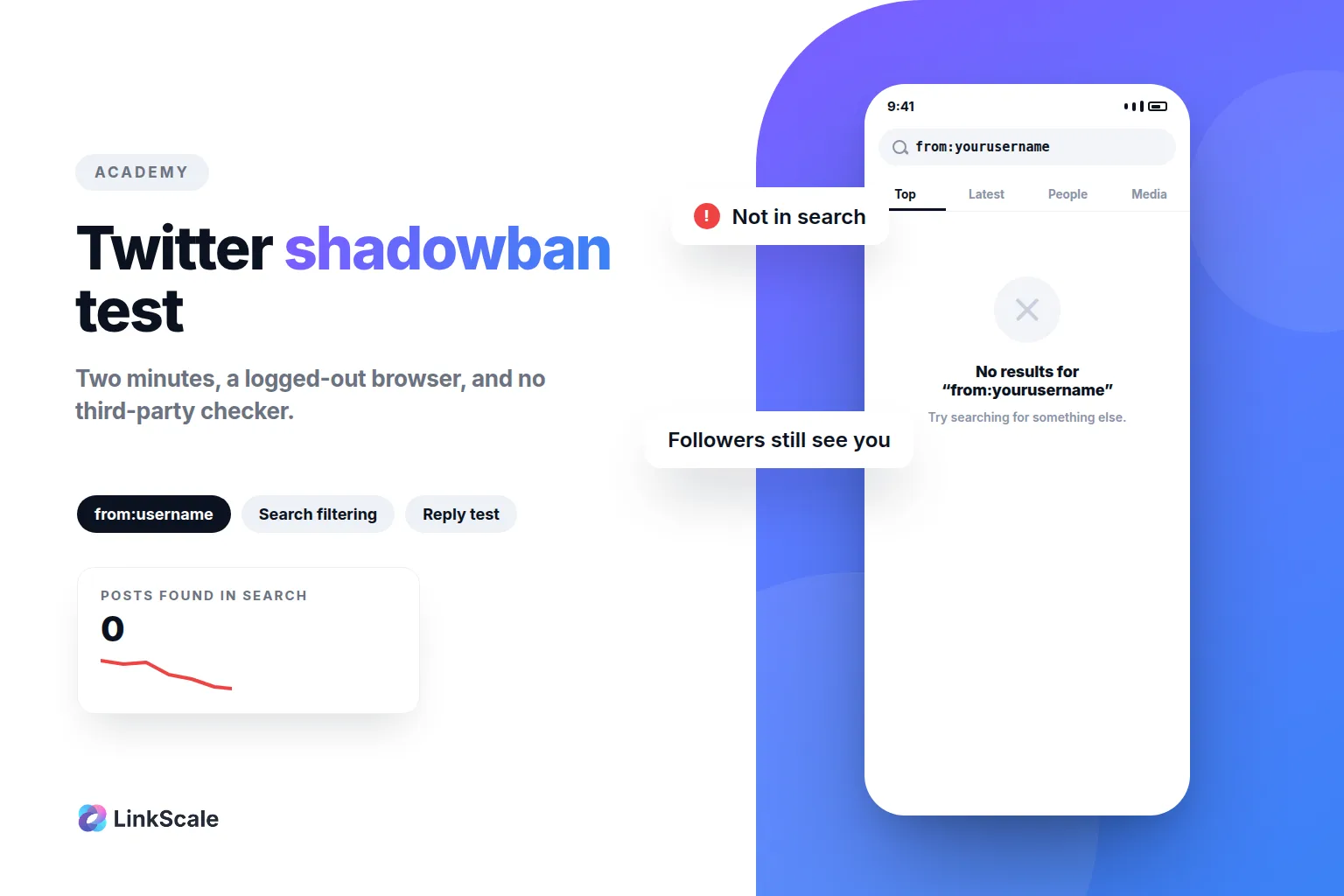
To check for a Twitter shadowban, run four searches from a logged-out browser: from:yourusername, an exact phrase from a recent post, your replies under a popular thread, and your @ in the search bar. If your posts vanish from search while your followers still see them, your account is filtered. The whole check takes two minutes and no checker tool can see more than these searches do.
X does not use the word "shadowban", but it documents the behaviour. Its search policyOpens in a new tab says filtered accounts still reach their followers. That asymmetry is what every test below is looking for.
Twitter shadowban check: the 4 tests at a glance
Open a private window, stay logged out, and replace USERNAME with your handle, without the @.
Run all four before you change anything. The pattern of which ones fail tells you more than any single result.
How to run each shadowban test on X
Test 1: the search ban test
Go to x.com/search?q=from%3AUSERNAME&f=live in a logged-out window. The f=live part shows the Latest tab, which removes the ranking and shows everything search is willing to show.
Your posts from the last few days appear: search visibility is fine. Nothing appears, or only old posts: your account is filtered from search. This is the one X documents, and the one that costs the most reach, because every stranger who could find you through a keyword stops seeing you.
Test 2: the exact-phrase test
Pick a phrase from a recent post that nobody else would write, and search it in quotes, still logged out. If Test 1 passed but this post does not come up, the filtering is on the post, not the account. That usually points at the content of that post: a link, a word, or media flagged as sensitive.
Test 3: the reply deboosting test
Reply to a large account's post. Then open that thread from a logged-out window, or from an account that does not follow you. If your reply sits at the bottom behind "Show more replies", or under "Show probable spam", your replies are being ranked down.
This is the most common restriction we see on accounts that promote, and the one people notice last, because their own view of the thread looks normal.
Test 4: the search suggestion test
Start typing your @ in the search bar of a logged-out window and stop before pressing enter. If your account does not appear in the dropdown while smaller accounts with similar names do, you are missing from search suggestions. This one is not described in X's documentation. Checkers report it because it is observable, and it tends to appear together with Test 1.
Read the results together
What a Twitter shadow ban checker actually does
Online shadow ban checkers run the same four searches automatically, from their own servers, and turn the result into a verdict. That makes them fast. It does not make them better informed: no checker has access to X's internal state, because X does not expose it.
Two limits follow. Checkers depend on X's search responding normally to their servers, so an outage or a rate limit on their side can read as a ban on yours. And a single run is a snapshot: search filtering can come and go within a day. Use a checker as a first hint, then confirm with the manual tests above, twice, a day apart.
The signature that confirms it
Here is what separates a real filtering event from a bad week. X's search policy states that when an account is filtered, your followers will still receive your updatesOpens in a new tab, and replies and mentions are still delivered.
So the signature is asymmetric. Engagement from existing followers stays roughly normal. Everything from outside your follower graph collapses. If both dropped at the same time, you are looking at a content or timing problem, not a filter.
Why X filters an account from search
Duplicate posts and duplicate links
X's policy names this one directly: accounts may be filtered for posting duplicate or near-duplicate content, links included, or for posting similar messages over several accounts. If you run more than one account, read that twice. The system is not judging your offer. It is detecting that the same message and the same URL appear in several places.
Behaviour that reads as automated
Follow and unfollow cycles, mass replies, posting on a fixed clock, identical calls to action. X's policy also names bots that post similar messages based on keywords. None of these is fatal alone. Together they describe a bot.
Unlabeled sensitive content
X allows consensual adult content, but its adult content policyOpens in a new tab requires you to label it, and forbids it in highly visible areas such as your profile picture and header. Unlabeled media, or adult content in the header, is one of the fastest routes to reduced visibility for creator accounts.
Reports, blocks and mutes
These accumulate without any notification. A run of blocks after a promotional push is a signal you only influence by changing what you post.
Is it a shadowban, or is it your links?
This is the test almost nobody runs. Post the same idea twice over a few days, once as plain text, once with a link, and compare impressions.
If your text posts are fine and your link posts die, your account is not filtered. Your links are. Two mechanisms stack here. The first is X's own duplicate-link rule. The second is domain reputation: a domain shared by many accounts carries the history of all of them, and one report against any of them makes the address suspect. We explain why in why a custom domain matters for bio links.
The rule that follows is dull and effective: one domain per account, never the same link pasted across all of them. Instagram works the same way, as covered in our Instagram shadowban guide.
How to get unshadowbanned on X
There is no button, and anyone selling one is selling hope with a checkout page.
- Stop the signal. Pause duplicate posts, reposting the same link, automation and mass replies.
- Fix what is visible. Label sensitive media, and remove adult content from your profile picture and header.
- Behave like a person for several days. Original posts without links, normal replies, no copy-paste.
- Remove recent duplicates, not your history. A mass deletion is an unusual pattern in itself.
- Retest. Run the four tests again after three to five days, from a logged-out window.
If X shows a notice that your account is locked or limited, that is a different state with an official route: the locked and limited accountsOpens in a new tab page explains each state and how to appeal.
What does not work
Deleting everything. It removes the history that makes an account look real.
Buying engagement to "reset" the algorithm. It adds low-quality signals to an account already judged on signal quality.
A new account pointing at the same link. The fastest way to turn one filtered account into two, since duplicate links across accounts are exactly what X filters.
Where the link layer fits
If your account earns by sending people somewhere, the link is part of the account. A domain you control, one per account, and a way to see whether a click actually arrived turn "my reach died" into a problem you can locate. That is the layer LinkScale handles. For the other platforms, banned from posting on Instagram covers the equivalent restriction on Meta's side.
Frequently asked questions
How do I know if I'm shadowbanned on Twitter?
Search from:yourusername in a logged-out browser. If your recent posts do not appear while your followers still see and like them, your account is filtered from search. Confirm with the reply and search-suggestion tests.
Are Twitter shadowban checkers accurate?
They run the same public searches you can run yourself and cannot see X's internal state. Use them as a hint, then confirm manually, twice, a day apart.
How long does a Twitter shadowban last?
X publishes no duration, because there is no formal state called a shadowban. Filtering usually lifts within days once the behaviour that triggered it stops. Locked or limited accounts follow the appeal process instead.
Can a link get my X account shadowbanned?
Posting the same link repeatedly, or across several accounts, is named in X's search policy as a filtering trigger. One link in your bio is not the problem. The same link everywhere is.
Does X shadowban adult content?
Adult content is allowed if it is labeled. Unlabeled adult media, or adult content in your profile picture or header, breaks X's policy and reduces visibility.
Is a shadowban the same as a suspension?
No. A filtered account stays fully usable and visible to followers. A suspension removes access. A limited account sits between the two.
Updated 30 September 2026. Written by Thomas Melto, CEO of LinkScale.