

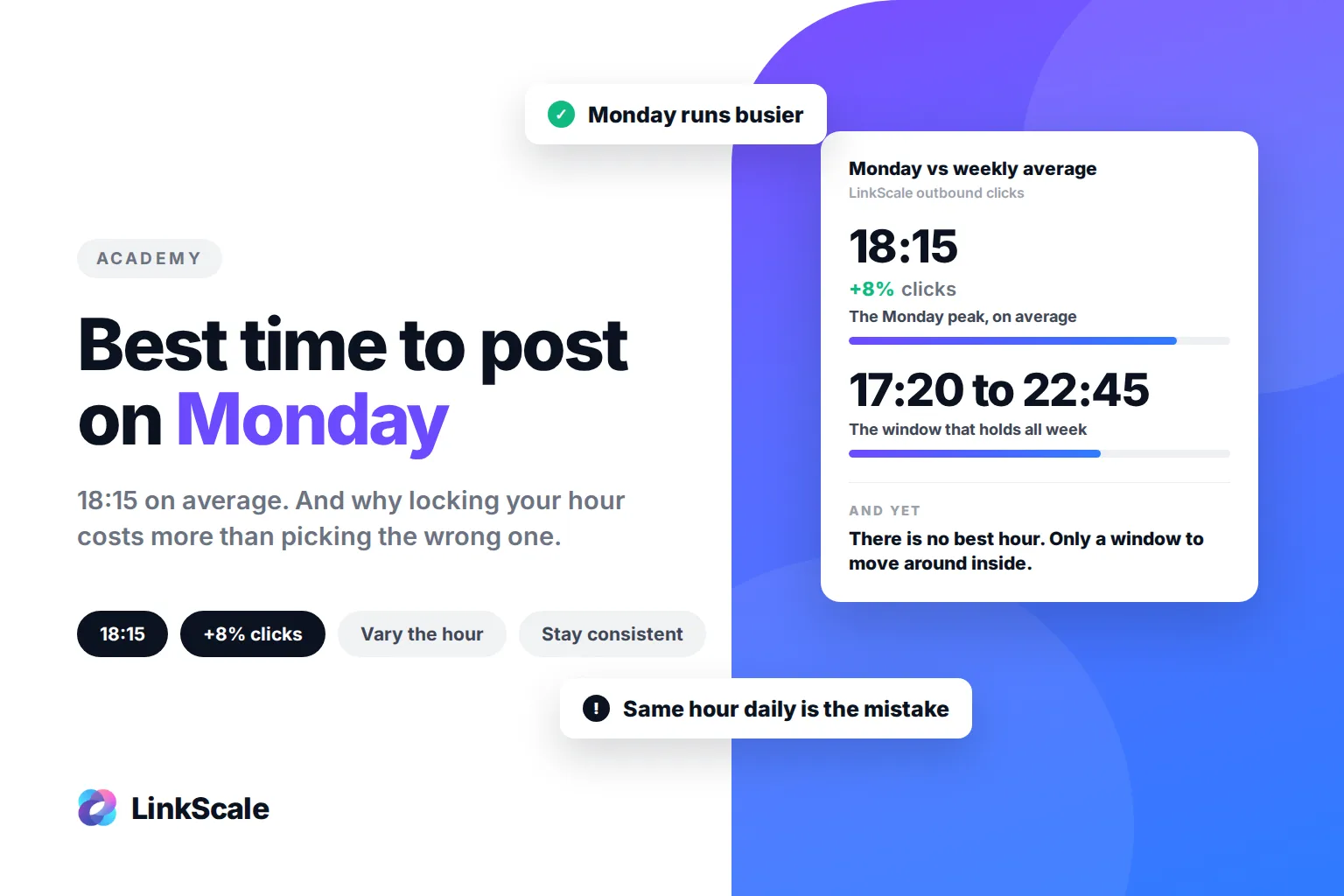
The best time to post on Instagram on Monday is around 18:15, when outbound clicks peak on our links. But the hour is not what decides whether your Monday post works. Posting at the same time every day is the mistake that costs more than any badly chosen slot, and Monday is the easiest day to fall into that habit.
Monday does carry a real advantage. More people are connected, the week restarts, and attention comes back after the weekend. That advantage is measurable but modest, and it disappears entirely if your account has settled into a robotic schedule.
How to pick the best time to post on Instagram on Monday
Start at 18:15 and treat it as a centre of gravity, not an appointment.
Use the window, not the minute
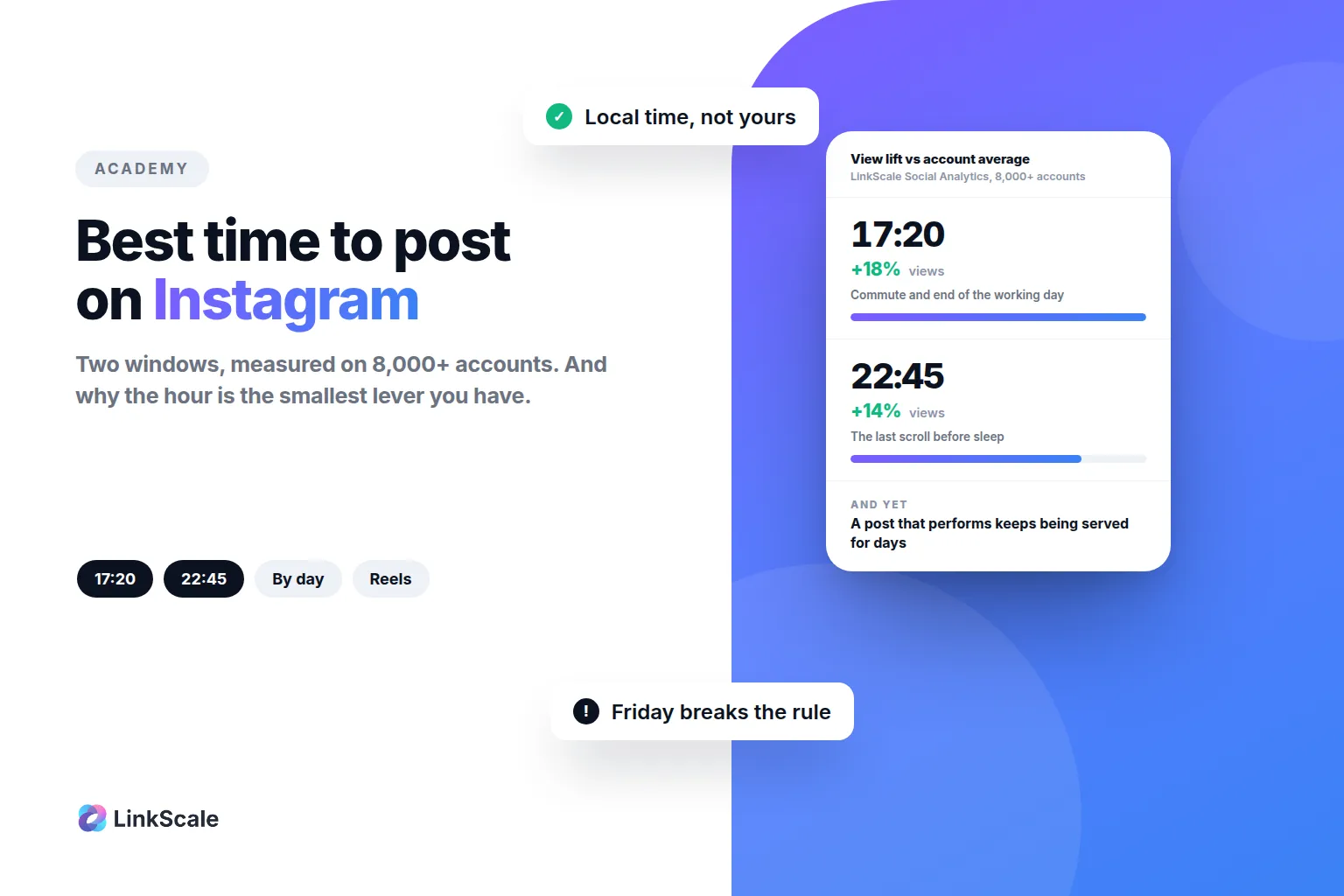
Our click data puts the Monday peak at 18:15 on average, inside the broader 17:20 to 22:45 window that holds across the week. The average is the useful part. Any single Monday can peak an hour earlier or two hours later, and chasing that variation week to week is wasted effort.
A workable approach: pick a slot somewhere between 17:00 and 22:00, and let it move by thirty to ninety minutes from one Monday to the next. You stay inside the window where your audience is awake and scrolling, without ever posting twice at the same minute.
Vary the hour on purpose
This is the part most creators get backwards. Publishing every single day at 18:00 sharp is a pattern, and patterns look automated. You are not a robot, and an account that behaves like one gives Instagram no reason to treat it like a person.
We have seen accounts post at 07:00 one day and 23:00 the next with no penalty at all. The spread is not a problem. The rigidity is.
Why Monday gets more clicks than the rest of the week
The 8% we measure
Across LinkScale links, as of September 2026, Monday carries roughly 8% more outbound clicks than the weekly average. The measure is outbound clicks on links we serve, not impressions on the post itself, which is why it differs from the numbers you will find elsewhere. That is a real gap, large enough to see clearly in aggregate, and small enough that it will never rescue a post nobody wants to click.
Eight percent is worth knowing. It is not worth reorganising your entire content calendar around.
What does not change on Monday
We looked for differences by destination type and found none worth reporting. A link pointing to a shop behaves the same on Monday as a link pointing to a video or a newsletter. Intuition says purchases cluster later in the week, and that may well be true of completed sales, but the click itself does not care which day it is.
So there is no Monday-specific content strategy hiding in the data. There is just a slightly busier day.
What matters more than the hour you post
If you only change one thing after reading this, change this one.
Consistency beats optimisation
Posting five times a week for a year beats posting five times a day for a month and then vanishing for six. Instagram's own ranking documentationOpens in a new tab describes a system built on sustained signals, not on isolated spikes, and the Meta Transparency CenterOpens in a new tab sets out how feed ranking weighs a creator's ongoing activity rather than a single well-timed post.
Decide on a rhythm you can actually hold. Five posts a week, one every two days, whatever fits your production capacity. Then hold it for months. Missing one is fine. Abandoning the rhythm is not.
The mistake we see most
The single most common error, by a wide margin: locking a publishing schedule to one fixed hour because a blog said it was optimal.
We have watched clients who posted daily at 17:30 for months switch to a varied schedule inside the same evening window, and see their results improve. Nothing else changed. They simply stopped being predictable.
18:00 is not the best hour. There is no best hour. There is a window where your audience is available, and there is the discipline to keep showing up inside it without becoming a metronome.
If a post is going to break out, it will break out. Instagram's guidance for creatorsOpens in a new tab is consistent on this point: reach follows what the content earns, not the clock.