

LinkScaleLinkScale

Best time to post on Instagram: 17:20 and 22:45, and why it barely matters

The best time to post on Instagram is 17:20 and 22:45 local time, worth 18% and 14% more views across 8,000+ accounts. And why the hour is your smallest lever.

Written byReviewed byRobin Bosca
Published on 8 min readReviewed in-house
Best time to post on Instagram: 17:20 and 22:45, and why it barely matters

Written by Thomas Melto, CEO of LinkScale. Last updated September 6, 2026.

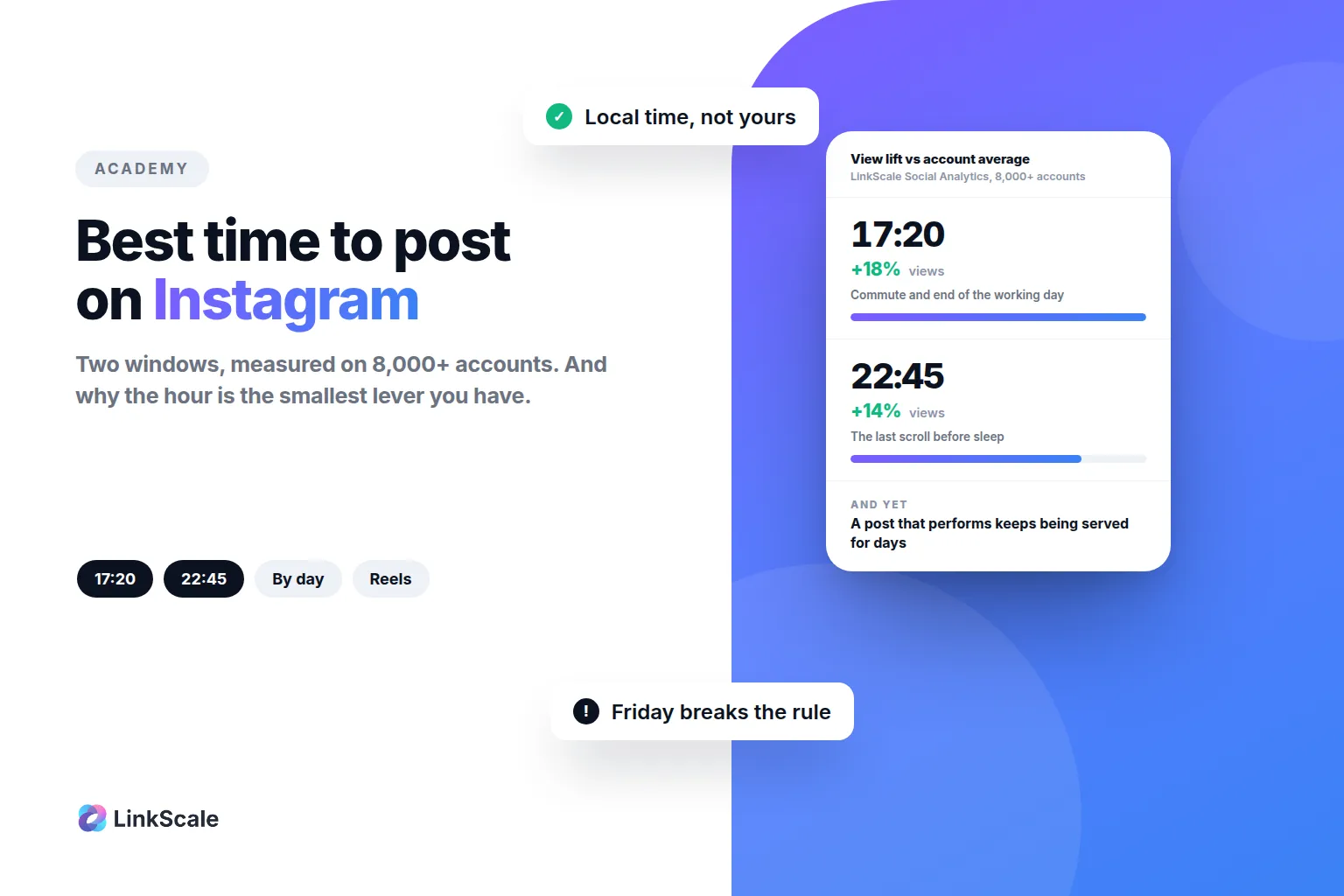
The best time to post on Instagram is 17:20 and 22:45 in your audience's local time. Those two windows came out of LinkScale's Social Analytics data across more than 8,000 Instagram accounts: posts published at 17:20 picked up 18% more views than the same account's average, and 22:45 picked up 14% more.

Now the part nobody selling you a scheduling tool will tell you: that is a marginal gain, not a lever. A post that deserves to work will work at four in the morning, because Instagram keeps re-serving what performs, for days. The hour buys you a nudge on the first hour of distribution. It does not decide the outcome.

Here is what the data says, what it does not say, and what actually moves your numbers.

What the best time to post on Instagram actually is

The two windows: 17:20 and 22:45

Both sit where you would expect if you think about a phone rather than a marketing calendar. 17:20 is the commute and the end of the working day. 22:45 is the last scroll before sleep, which is the densest attention window of the entire day and the one most schedulers miss because it feels too late.

The gap between the two is the interesting part. The evening window is smaller in lift but the audience is more captive: nobody is at 22:45 on Instagram between two other tasks.

One detail from our own numbers that surprised us: the click on the bio link follows the view within minutes, not hours. We expected people to see a post in the evening and act the next morning. They do not. They tap while they are still in the app. That single fact changes what you should optimise, and we come back to it at the end.

What these numbers do not say

Being precise here matters more than being impressive.

They are a view lift measured against each account's own average, not a guarantee, not a conversion figure, and not a promise that your account behaves like the median of 8,000. They held steady across verticals and across mobile and desktop, which is itself informative: this is not a niche effect, it is a human-schedule effect.

They also do not mean 17:19 or 17:22 are meaningfully worse. Treat those two times as the centre of a window of roughly twenty minutes either side. Anyone quoting you a best minute is selling precision they do not have.

Why the hour matters far less than everyone says

Instagram re-serves what performs, for days

This is the mechanism that makes most posting-time advice obsolete, and Instagram is fairly open about it: distribution is driven by predicted interest per viewer, not by a publication timestamp. Meta has published its own explanation of how Instagram ranking worksOpens in a new tab, and the short version is that a post keeps being shown to people who are likely to engage with it, well after it went up.

In practice that means a Reel posted at 03:00 that holds attention gets pushed into feeds the next evening, and the one after. A Reel posted at 17:20 that nobody watches to the end stops travelling within the hour.

So the hour affects your first hour. The content affects the next week. If you have limited energy, and everyone does, that tells you exactly where to spend it.

What that means for your schedule

Post when you can post consistently. A creator who publishes at 09:00 every day because that is when they actually have time will beat one who publishes at 17:20 twice a week because the perfect slot never fits.

Then, once consistency exists, shift toward the windows. In that order, not the reverse.

Best time to post on Instagram by day of the week

The two windows hold every day. What changes across the week is the behaviour around them, and that is what you can actually act on. Below is what we would do on each day, with the reasoning rather than a fabricated percentage per day.

DayThe windowWhat is different
Monday17:20The heaviest catch-up scroll of the week, and also the noisiest feed. Strong reach, more competition.
Tuesday17:20 and 22:45The cleanest day. Routine is settled, the feed is less crowded than Monday.
Wednesday22:45Midweek fatigue favours the evening window over the commute one.
Thursday17:20Attention starts drifting toward the weekend, which helps anything aspirational or plan-shaped.
Friday17:20, earlier if you canThe evening window collapses. People leave the app for actual plans, so publish before they go out.
SaturdayLate morning, then 22:45The commute window does not exist. The day shifts later and flattens out.
Sunday22:45The strongest single evening slot of the week, because Sunday night is when people plan the week and scroll longest.

Monday and Tuesday

Monday buys reach and pays for it in competition, since half the accounts you compete with also post on Monday. Tuesday is where we would put anything that has to land: same attention, thinner feed.

Friday through Sunday

Friday is the one day the standard advice actively misleads you. The 22:45 window fails on Friday because your audience is out. Publish in the late afternoon or accept a weaker night.

Sunday is the opposite and it is underused. Sunday at 22:45 combines the longest sessions of the week with a mood that is receptive to anything about starting, planning or changing something.

Best time to post Instagram Reels

Same two windows, with one adjustment: Reels travel further than feed posts and for longer, so the publication hour matters even less for them.

Where the hour does count for Reels is the first fifteen minutes, because early completion rate is what decides whether the Reel gets pushed beyond your followers. So the question for a Reel is not what hour gets the most scrollers, it is what hour gets the most of your people, the ones likely to watch it through. That is usually the evening window, not the commute.

How to find your own best time in ten minutes

Stop reading averages, including ours, and read your own account.

Open Instagram Insights, go to your audience, and look at the most active times of your followers. Instagram documents how to view your InsightsOpens in a new tab and it gives you the distribution by hour and by day for your specific audience. That beats every study ever published, including this one, because it is your audience and not a median.

Then run it properly:

  1. Note your account's average views over the last twenty posts. That is your baseline.
  2. Post at 17:20 for two weeks, same format, same rhythm.
  3. Post at 22:45 for two weeks.
  4. Compare against the baseline, not against each other.

Two weeks per window, minimum. A single post tells you nothing: variance between two posts by the same account on the same subject is far larger than an 18% timing effect, so a one-post test will convince you of whatever you already believed.

The thing that actually moves the number

Here is the part that will be uncomfortable if you came here to fix your schedule.

We measured that the click on a bio link happens within minutes of the view. Which means the entire chain, seeing the post, wanting the thing, tapping the profile, reading the bio, tapping the link, arriving somewhere, happens in one uninterrupted movement while the person is still in the app.

So the honest hierarchy of what decides your results looks like this, and the hour is at the bottom:

  1. Whether the content earns attention. Nothing below matters otherwise.
  2. Whether the profile converts a viewer into a tap. Your bio does this work, and most bios do it badly. We took that apart in how to write an Instagram bio.
  3. Whether the link survives the tap. A link that opens inside Instagram's own browser lands the visitor logged out of everything, with no saved passwords and no payment method. In our data, links handed off to the visitor's real browser reached 71% conversion on the destination platform. The mechanism is in what is a deep link.
  4. Whether you can tell which post sent which click. One link for everything tells you nothing. The comparison of what actually differs between tools is in link in bio tools.
  5. The hour you posted. Worth 18% on views, at best, and only on the first hour.

Optimising step five while step three leaks most of your traffic is the most common mistake we see. An 18% view lift on a funnel that loses people at the tap is 18% more of nothing.

That is the part LinkScale handles: the handoff to the real browser, your own domain, and a tracked link per source so you know which post at which hour actually produced the click. Which, incidentally, is how you would run the test in the previous section properly.

FAQ

What is the single best time to post on Instagram?

17:20, then 22:45, in your audience's local time. In our data across 8,000+ accounts those windows produced 18% and 14% more views than the accounts' own averages. Treat them as twenty-minute windows, not exact minutes.

Does posting time still matter in 2026?

Marginally. Distribution is driven by predicted interest rather than recency, so a post that performs keeps being served for days. The hour affects your first hour of reach and very little after that.

Is it bad to post at 3 in the morning?

Not if the content is good. You lose the initial push, and you get it back over the following days if people watch it through. A strong post at a bad hour beats a weak post at a perfect one, every time.

What is the best time to post Reels specifically?

The same windows, but the hour matters even less because Reels keep circulating longer. Prioritise the slot where your own followers are most likely to watch to the end, which is usually the evening.

How do I find the best time for my own account?

Instagram Insights shows the most active hours of your specific followers. Use that, then test one window for two weeks against your last twenty posts as a baseline. Never conclude from a single post.

Should I use a scheduling tool to hit these times?

If it makes you consistent, yes. Consistency is worth much more than precision here. If it makes you post at a good hour once a week instead of a decent hour daily, it is costing you.

Written by

, Founder & CEO, LinkScale

Builds LinkScale daily with the creators and agencies who run their business through their bio link.

Reviewed by Robin Bosca, Co-founder & CTO, LinkScale

Keep going with our content on branded links, landing pages and analytics.

Academy

How to avoid a shadowban on Instagram

A shadowban is a loss of recommendation eligibility, and Instagram tells you in the app. How to check it in 30 seconds, what causes it, and what actually fixes it.

+100% conversion